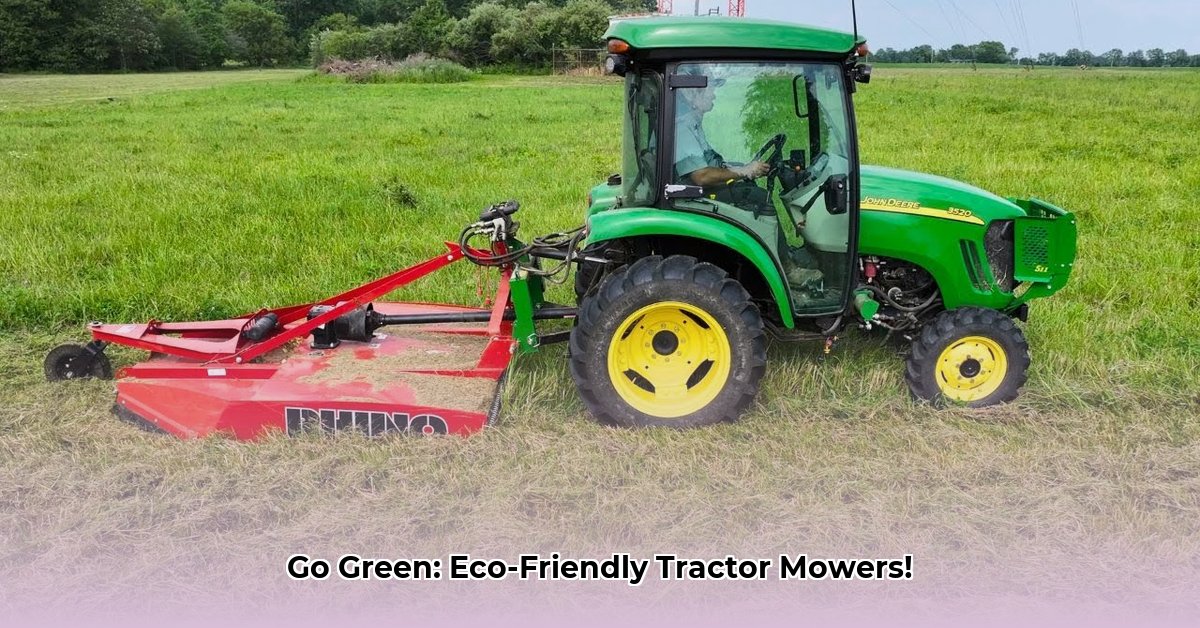
Sustainable farming practices are no longer a niche concept; they're essential for the future of food production. Mowing, often overlooked, significantly impacts soil health, environmental impact, and overall farm efficiency. For electric options, check out electric tractors. This guide provides actionable steps for choosing and using sustainable tractor mowers, empowering you to cultivate a greener, more profitable farm.
Finding the Right Mower for Your Sustainable Farm
Selecting the ideal tractor mower hinges on several crucial factors. Consider these key aspects carefully:
Matching Mower to Terrain and Crops
Your land's topography dictates the appropriate mower type. Rotary mowers excel on flat, even fields, providing a clean cut ideal for grassy areas or hay. Flail mowers, however, handle rough, uneven terrain and dense vegetation, including brush and weeds, with greater ease. What type of crops are you working with? Knowing this helps determine the necessary cutting height and style.
Scaling Mower Size to Your Operation
Farm size directly influences mower selection. Smaller farms might find manual tools or compact tractor mowers sufficient, while larger operations require higher-capacity equipment for efficient coverage. Overestimating your needs leads to unnecessary expenses and potential environmental impact; underestimating can lead to inefficiencies and increased labor. Finding the sweet spot is key.
Budgetary Considerations for Sustainable Choices
Mowers span a wide price range. Establishing a realistic budget upfront prevents overspending and ensures a financially sustainable choice. Remember, the initial investment should balance with long-term operational costs, including fuel consumption and maintenance. Consider leasing or exploring government subsidies to reduce the upfront financial burden.
Sustainable Mowing Techniques: Beyond the Machine
Sustainable mowing involves more than just equipment; it's about how you mow. These practices maximize efficiency and minimize environmental impact:
Timing Your Cuts for Optimal Growth
The timing of mowing significantly influences plant health and soil erosion. Mowing overgrown fields can damage them. Consider factors like the time of year, weather patterns, and water availability for optimal results. Avoid mowing when the soil is excessively wet, as this contributes to soil compaction.
Maintaining Optimal Cutting Height
Leaving some stubble after mowing protects the soil, prevents erosion, and promotes plant health. Experiment to determine the optimal stubble height for your specific crops and soil conditions. Generally, a higher cutting height is preferred for soil health and efficient regrowth.
Regular Mowing for Healthy Growth
Frequent, shorter mowing often surpasses infrequent, deep cuts in promoting healthy regrowth. Regular trims, similar to maintaining a lawn, keep plants healthy and prevent excessive growth that can shade out desirable plants. This helps manage weeds and promotes a healthy plant ecosystem.
Rotary vs. Flail Mowers: A Detailed Comparison
The choice between rotary and flail mowers requires careful consideration. This table highlights their key differences:
| Feature | Rotary Cutter | Flail Mower |
|---|---|---|
| Cutting Style | Sharp spinning blades for clean cut | Swinging flails beat and cut vegetation |
| Terrain Suitability | Smooth, flat fields | Rough, uneven terrain |
| Vegetation Suitability | Grasses, hay | Tough vegetation, brush, debris |
| Soil Impact | Potential for soil compaction at high speeds | Lower soil compaction risk |
| Maintenance | Blade sharpening and regular checks | More frequent cleaning and maintenance |
"Choosing between a rotary and flail mower depends entirely on the specific needs of your farm," says Dr. Anya Sharma, Agricultural Engineering Professor at the University of California, Davis. "A thorough analysis of your terrain and vegetation is crucial before making a decision."
Embracing Technology for Precision Mowing
Precision agriculture technologies, like GPS-guided tractors, optimize mowing patterns, reducing overlaps and fuel consumption. These systems minimize resource wastage and improve overall efficiency.
The Future of Sustainable Mowing: Innovation and Collaboration
The future of sustainable mowing involves continuous improvements in equipment efficiency, the exploration of alternative fuels (such as biodiesel), sensor technology for optimized mowing and advanced data analytics. Collaboration among farmers, researchers, and equipment manufacturers is essential to achieving truly sustainable mowing practices.
Actionable Steps for Sustainable Mowing
- Assess your farm's needs: Determine acreage, terrain, crop types, and budget.
- Choose the right mower: Select a mower compatible with your farm's characteristics.
- Implement sustainable mowing practices: Maintain optimal cutting height, utilize sharp blades, and schedule regular maintenance.
- Explore technology: Consider GPS-guided tractors for greater efficiency.
- Embrace continuous improvement: Stay informed about emerging technologies and sustainable practices.
By incorporating these strategies, you can achieve sustainable mowing practices, maximizing efficiency while minimizing the environmental footprint of your farming operation. The result? A healthier farm, a more sustainable future, and a boosted bottom line.